
New Moon-Phase Watches Echo the Hues of the Sea and Sky.
A watch’s moon-phase indicator sparks the imagination and adds a connection to nature’s ways. While reading the moon’s phases on a watch is not necessary in the 21st century, the fascination with the celestial body’s beauty and movement persists. A moon phase remains a favorite complication among watch collectors and enthusiasts — and it is a clear indication of superb watchmaking craftsmanship. This year, a blue wave has swept through watchmaking, with top Swiss brands Audemars Piguet, IWC Schaffhausen, Breitling, Blancpain and Chopard introducing new moon-phase timepieces, with or without additional complications, echoing the hues of the sea and sky.
In ancient times, the phases of the moon were used to track the passage of time. As early as the fifth century B.C.E., the Babylonians were using the moon phases as a calendar, while Egyptians were using their own form of a lunar calendar, which was especially helpful in predicting the annual flooding of the Nile River. Knowing when to expect the light provided by a full moon was also helpful for nighttime travelers and soldiers. Mariners knew to expect higher tides when the moon was full, and the position of the moon and stars aided in navigation.
A Mini-Moon on the Wrist
In most watches with moon-phase indicators, the moon is seen through an aperture on the watch’s dial. Generally, the moon-phase aperture is semicircular in shape, creating a window through which the moon — depicted using enamel, gold or other materials — can be seen. Beneath the aperture, a slowly rotating disc featuring two moons travels at the rate of the moon cycle, which is 29.5 days in length.
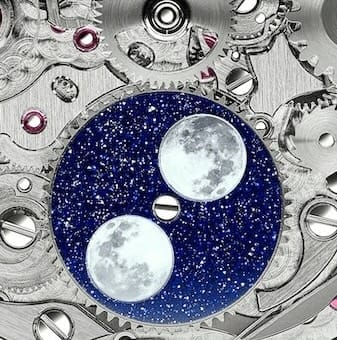
As the disc rotates, it displays the visible portion of the moon that will appear that day. As time passes, the portion of the moon that shows through the aperture changes with the waxing and waning of the moon phase. As the moon progresses through its regular orbit, the visible portion of the moon becomes larger.

Blue Wave
The new IWC Schaffhausen stainless steel Ingenieur Perpetual Calendar 41’s deep blue dial features the signature grid pattern of all Ingenieur timepieces. Its moon phase features a detailed azurage finish, an intricate pattern of concentric circles that gives the illusion of moving waves. The watch is powered by IWC’s caliber 82600 self-winding movement featuring ceramic components.
About Face
While the Blancpain Ladybird Moonphase boasts a robust mechanical movement and over 2 carats of diamonds, its most distinctive feature lies within the aperture at 6 o’clock – a whimsical depiction of the moon. The gold disc features a blissful feminine face in repose, with its boldly-eyelashed eyes closed. The beauty mark is a nod to the fashions of the 1700s, the century of Blancpain’s founding.


NASA Precision
Despite their diminutive size, moon-phase displays can offer surprising detail. The perpetual calendar on Audemars Piguet’s new blue-dialed Code 11.59 moon phase “displays a realistic depiction of the moon based on a NASA photograph,” according to the brand. The new Code 11.59 by Audemars Piguet is equipped with Audemars Piguet’s new self-winding perpetual calendar movement, the Caliber 7138, which was created to mark the beginning of the brand’s 150th anniversary.
Sparkle Aplenty
Chopard’s new L’Heure du Diamant Moonphase timepiece features a diamond-set bezel surrounding its blue aventurine glass dial. The moon phase’s disc is also crafted of aventurine, lending the watch a look of stars in the sky. The self-winding Chopard 09.02-C, a new movement, powers the watch and its celestial display. The 09.02-C is the first complicated movement in Chopard’s L’Heure du Diamant collection.


Navigating the Skies
Breitling’s new Navitimer B19 Perpetual Calendar Chronograph features an ice blue dial surrounded by a platinum bezel. Its moon phase has a highly detailed rendering of the moon surrounded by stars. Originally designed in 1952 for the Aircraft Owners and Pilot’s Association, the Navitimer was known as the first wristwatch flight computer, according to the brand. Its circular slide rule was, and is, capable of performing essential onboard navigation calculations.
Modern navigation techniques have eliminated the need for calculating direction based on the moon’s position, and countries adopted the Gregorian calendar in the late 16th century, which relies on the Earth’s orbit around the sun. While it’s unnecessary, the slow pace of a moon phase’s movement is a counterpoint to the hurried pace of everyday life. It encourages one to slow down and appreciate the value of time.