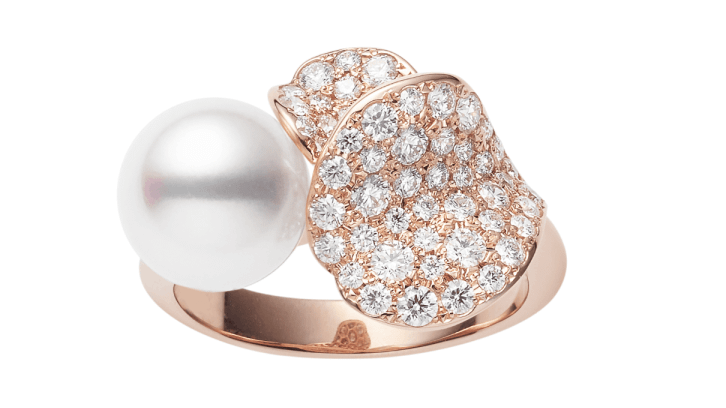
Mikimoto’s modern rose gold and pearl jewelry packs a stylistic punch.
Mikimoto, the world’s oldest and arguably most famous pearl jewelry brand, was founded in 1893 and has been in business ever since. Mikimoto’s founder, Kokichi Mikimoto, is credited with successfully growing the world’s first cultured pearls, greatly improving pearl production efficiency.
Mikimoto famously said, “My dream is to adorn the necks of all women around the world with pearls.” He devoted his life to pearls, according to the brand, so much so that he was sometimes referred to as the “Pearl King” in Japan.
All in the Family
While Mikimoto was not a true monarch, members of Japan’s imperial family wear Mikimoto jewelry, including tiaras, to state occasions. And the Mikimoto dynasty continues: One of Mikimoto’s descendants has a role in the family business to this day.
Culturing Pearls
The advantages of growing cultured pearls versus attempting to harvest natural pearls were clear to Kokichi Mikomoto. Natural pearls are very rare. Less than one in a thousand oysters will produce a natural (uncultured) pearl in their lifetime, and often those pearls are too imperfect to be made into jewelry. An oyster produces a pearl when a foreign body enters its shell as a defense mechanism. The oyster coats the foreign body with nacre, effectively shielding itself from any possible injury. Nacre layers smooth rough edges and seal the object off from the oyster.

Cultured pearls are “seeded” by farmers with a tiny non-toxic object, often a small sphere. The oyster will cover the tiny orb with layers of nacre, adopting its spherical nature as the pearl grows. A cultured pearl will remain inside the host oyster for two years or more, growing slowly over time. The pearl will then be carefully extracted from the oyster, ensuring minimal harm to the animal, and is either returned to the sea or reseeded. Pearl formation is an entirely organic process, all occurring within the host oyster.

Not Your Grandmother’s Pearls
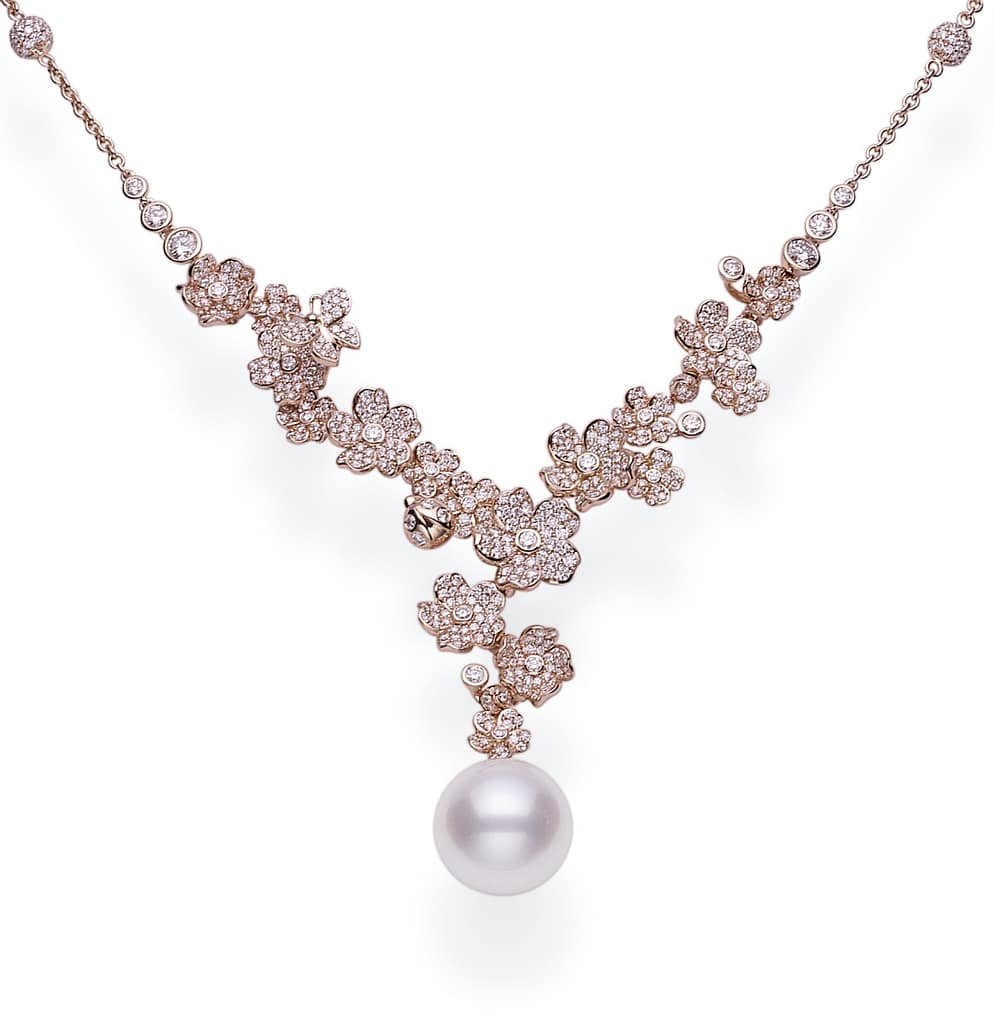
Pearls are traditionally best known as strung in necklace form, as Kokichi Mikimoto envisioned, but can be incorporated into other artful jewelry pieces to great effect. In recent years, Mikimoto has set pearls in rose gold to craft rings, brooches, bracelets and, of course, necklaces.
Many of the rose gold pieces pay homage to the iconic cherry blossom, which has long been a national symbol of Japan. While it is not Japan’s official flower, the cherry blossom evokes a symbol of new beginnings, springtime, and beauty in Japanese culture. Other recent rose gold and pearl designs are included in the brand’s Arabesque and V Code collections, offering additional modern takes on the classic pearl.