Jewelry designers Piaget, Van Cleef & Arpels, Monica Rich Kosann and Marina B capture opal’s legendary luminosity.
Opals are unique in the world of gemstones, offering a kaleidoscope of ever-changing colors as they reflect the light. This sparkling “play-of-color” has fascinated people across the globe for millennia. Mysterious and enchanting, opals have historically held numerous meanings across cultures, often relating to vision and eyes. The ancient Greeks believed that opals could help people see into the future, and historical belief in Europe was that opals could bend light, causing their wearers to be invisible.
The name opal is generally believed to be originally from India, which was the first source of opals for the Western world. In Sanskrit, the opal is called upala, meaning precious stone, and it’s believed the ancient Romans changed this to opalus. Other theories of the origin of the name opal include the Greek “opallis” which translates to “see a change in color,” or the Latin word “opalus” whose meaning is thought to be “precious jewel.”
Ray of Light
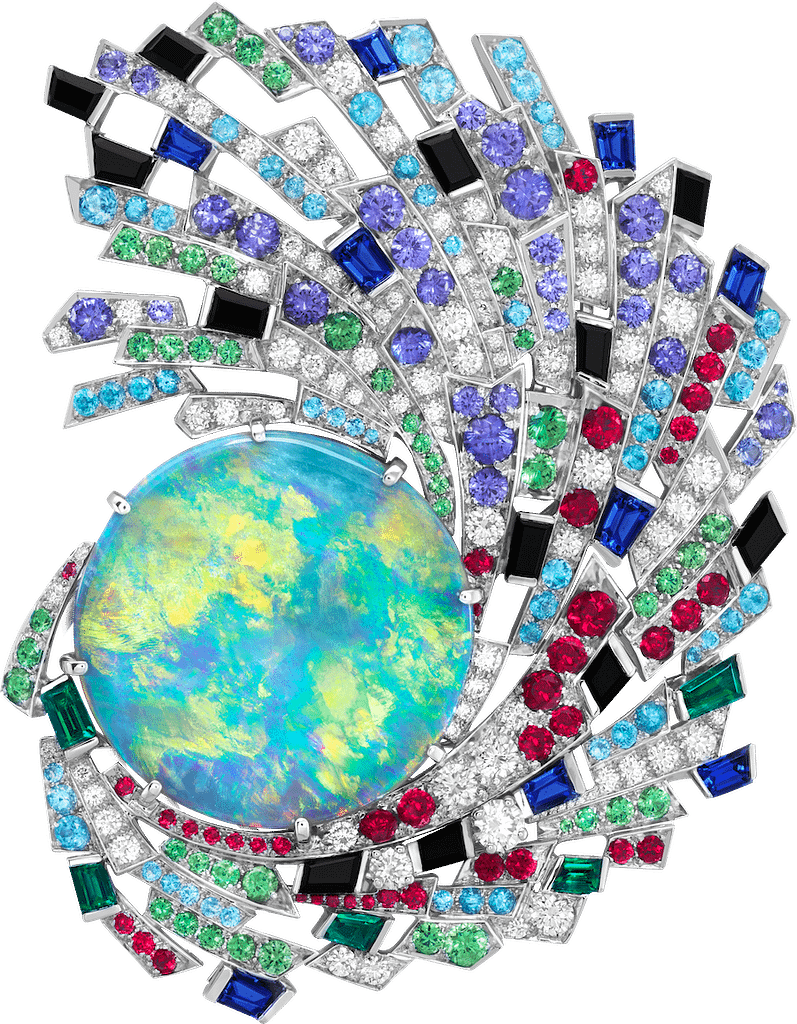
Whatever the origin of its name may be, the opal has a unique beauty and qualities that no other precious or semiprecious stone possesses. Unlike most other gemstones, which are formed with atom-level bonds and are crystalline in structure, opals are composed of tiny silica spheres stacked on top of each other in irregular patterns. The Van Cleef & Arpels Nébuleuse d’Opale clip pictured right is crafted of a 23-carat black opal, emeralds, rubies, colored sapphires, black spinels, tsavorite garnets, green tourmalines and diamonds.

Crystal Haze
Opal’s lack of fixed geometry that is present in diamonds and sapphires, for example, gives it a singular appearance. Opals are formed over centuries, as rainfall water carries silica from sandstone and it settles into underground cracks and voids. As the water evaporates, it leaves a silica deposit. The miniscule silica layers accumulate over hundreds of years and eventually an opal is formed. The Monica Rich Kosann Australian Crystal Opal locket ring pictured left is made of a translucent crystal opal, diamonds and rose gold.
A Flash of Color
As light moves through an opal’s silica spheres, the stone reflects colors as a result of the spheres’ irregular alignment. Certain trace chemicals that are present in the stone also contribute to these color “flashes.” Because no two opal stones have the exact same structure, each one is unique. Marina B’s Pollia earrings (one of the pair shown here) are crafted of opals, black onyx, blue topaz and diamonds set in yellow gold.


Abundant Brilliance
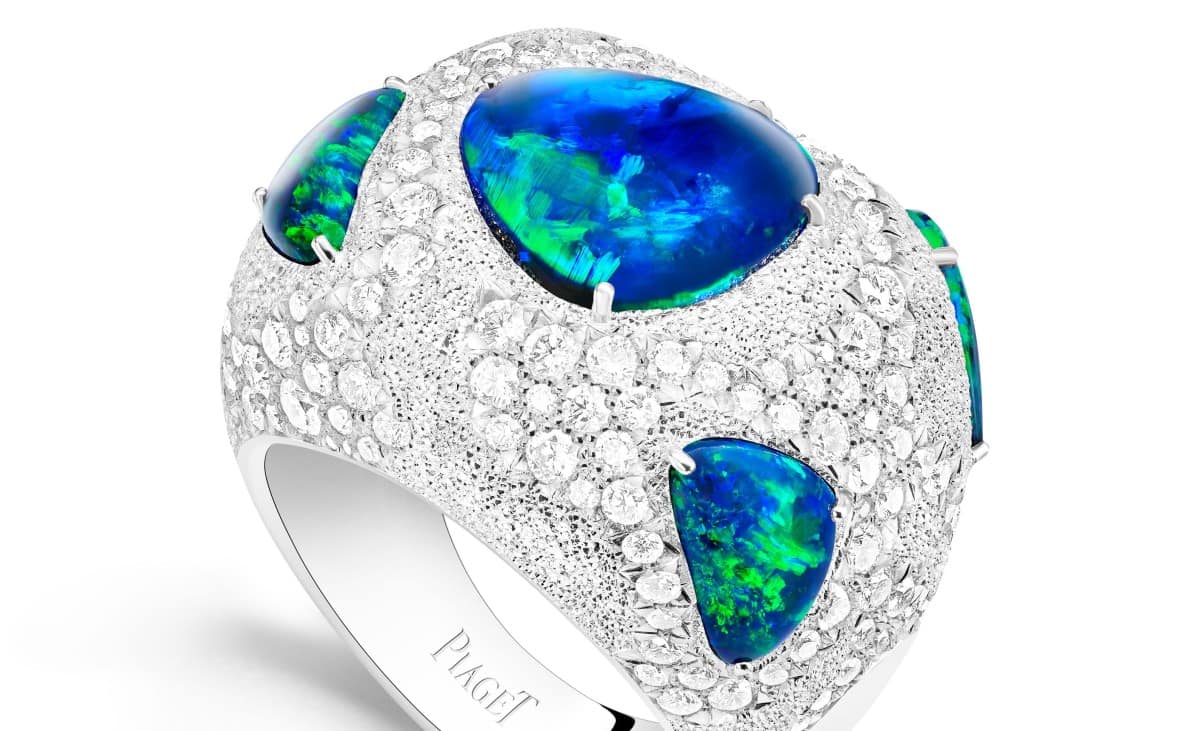
Opals are highly valued for this resplendent play of color, and generally the most prized for their color and brilliance are black opals. A black or very dark base color allows the play-of-color to appear particularly bright. Opals that are characterized as black can also have a base color of very dark blue, gray, green or brown. An overwhelming percentage of black opals come from Australia. Pictured left is the Piaget Shapes of Extraleganza High Jewelry ring, crafted of black opals and diamonds.
Perhaps the most famous—and most legendary—of all opals is the “Burning of Troy” opal that Napoleon gave to his wife Empress Joséphine. The opal, which is reported to have weighed more than 700 carats, was named for the bright, fire-red play-of-light it displayed. The Burning of Troy opal disappeared upon Joséphine’s death in 1814, and its current whereabouts are unknown. William Shakespeare called opals the “queen of gems” in his play the “Twelfth Night.” They are quite noble indeed.